The web hosting sector is in constant flux. By 2026, agencies and developers are no longer simply concerned with the question: “Who offers the lowest rates?” Instead, they are honing in on a more focused inquiry: which platform enables me to quickly set up client environments, brand everything under my identity, and avoid spending half my week managing servers?
This is a critical factor for agencies as it influences their business model and public image.
We present a guide on what cloud reseller hosting encompasses, which providers are currently favored by companies, and how to make selections that optimize profits while enhancing your agency’s image.
What Is Cloud Reseller Hosting?
Cloud reseller hosting involves procuring cloud-based server resources in bulk and reselling those resources to your clients as your personalized hosting service. You’re not constructing data centers or fussing with graphics cards. You serve as the intermediary between the infrastructure and the client, adding value through support, setup, and service.
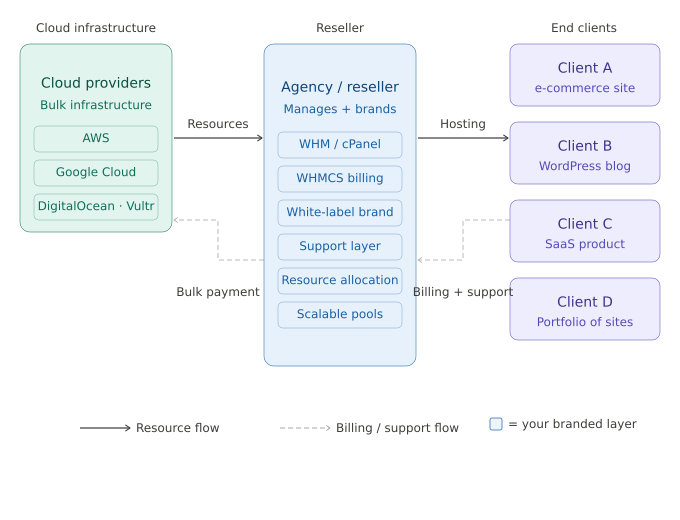
Most reseller configurations include a management layer (often WebHost Manager /cPanel) that facilitates the creation and management of client accounts. Billing is typically automated using software like WHMCS, which handles invoicing and provisioning without requiring manual intervention. If everything goes smoothly, it results in a hosting business that nearly manages itself.
The distinction between cloud reseller hosting and traditional reseller hosting lies in the location of the resources. Conventional reseller plans operate on shared or dedicated physical servers: they are finite, fixed, and lack elasticity.
Cloud reseller hosting relies on a horizontally virtualized infrastructure that is scalable. A surge in traffic prompts the allocation of additional resources. If any client exceeds their plan, there’s no need for migration, just an upgrade.
Common capabilities available to you as a reseller include:
– White-label branding: Your logo, domain, and name featured prominently
– Scalable resource pools: Allocate CPU, RAM, storage for each client account
– Automated customer administration: Account provisioning, suspensions, upgrades
– Billing integration: Automated invoicing, renewals, and payment collection
This model is effective for agencies, freelancers managing a portfolio of client sites, and developers seeking recurring revenue without the demands of a full-time sysadmin role.
Why Cloud Reseller Hosting Makes Sense in 2026
A few years back, reseller hosting was simply a WHM account purchased from a shared hosting company while crossing fingers for favorable outcomes. That worked – until it didn’t. Frequent frustrations included over-sold servers, rigid resource limitations, and unclear pricing structures.
The landscape in 2026 is different. Three significant changes make cloud reseller hosting particularly compelling today.
The platform economy has arrived.
Platforms that offer automation, staging, security, and support atop major cloud providers have matured. You can utilize AWS or Google Cloud infrastructure without the burden of a DevOps team to manage it. The platform takes care of operational complexities, allowing you to focus on client relationships rather than kernel updates.
FinOps thinking is now mainstream.
FinOps (financial operations for cloud environments) is no longer solely for enterprises. Agencies are also engaging in this practice, aligning each dollar of infrastructure expenditure with client revenue while ensuring margins are maintained as usage expands. Modern reseller platforms natively support this, providing usage dashboards and per-client cost tracking that streamline billing discussions.
AI tools are integrated rather than tacked on.
By 2026, leading platforms will feature AI-driven troubleshooting, anomaly detection, and performance enhancement directly in the control panel. This isn't a gimmick; it significantly reduces the time needed to resolve client issues for smaller agencies that lack dedicated support staff.
These transformations together simplify entry barriers and enhance what a lean agency can realistically offer.
Key Features to Look for in a Cloud Reseller Hosting Provider
Not every service that labels itself as “cloud reseller hosting” provides the same benefits. Before making a commitment, evaluate any provider against this checklist:
- White-label support: Is the customer-facing experience fully customizable? Dashboard, invoices, support portal?
- Per-account resource guarantees: Are resources isolated for each customer, or do you depend on shared pools that can be affected by noisy neighbors?
- Automated billing (WHMCS or similar): Manual invoicing on a large scale is a nightmare. This must be automated.
- Web server performance: LiteSpeed and NGINX out-perform Apache in most real world reseller scenarios. Well worth a look under the hood.
- Free SSL provisioning: Table stakes in 2026, but still worth double-checking if it’s included and auto-renewing
- Daily automated backups: For client sites, “we don't offer that” is not acceptable. Backups need to be automatic and restorable without a support ticket.
- Easier migrations: Are you able to migrate existing client sites without a lot of manual work?
- Security infrastructure: At the very least, you need a Web Application Firewall (WAF), DDoS protection and malware scanning. A WAF is a filter and monitor of HTTP traffic between web applications and the Internet. It blocks common exploits before they ever reach the client site.
- Compliance posture: If you have clients in regulated industries, you must be GDPR and PCI compliant.
- Support quality – who answers the phone when something breaks at 2am? What is the true SLA?
Eco-friendly hosting certifications and integrated developer tools are increasingly common differentiators too, worth noting if those matter to your client base.
Managed Aggregator vs. Traditional WHM/cPanel: Choosing Your Model
This is the decision most people ignore and regret later.
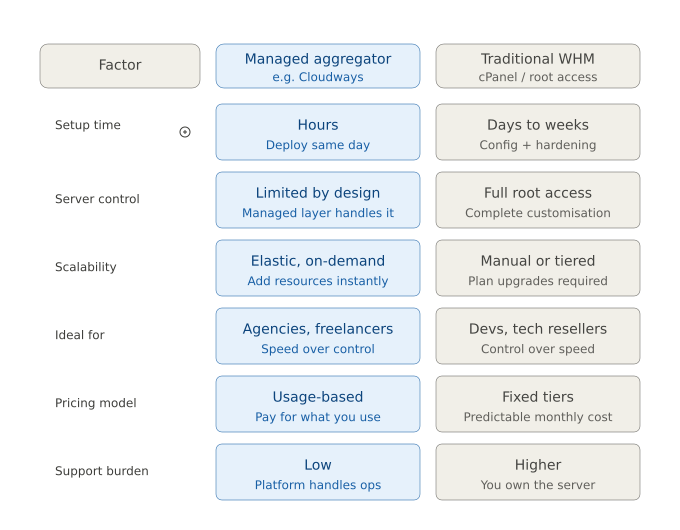
Granular control with traditional WHM/cPanel reseller hosting. Full server root access , customisation options and a widely known toolset that has been the standard for years . The downside is complexity. You are running the environment yourself. Updates, security patches, performance tuning: that is your job, or your team's job.
The approach of managed aggregator platforms is different. A managed aggregator provides automation, security, staging and support for all the big cloud providers, allowing you to get to market quicker, with less granular control over the servers. You lose a bit of configurability but you’re not having to worry about the infrastructure layer whatsoever.
| Factor | Managed Aggregator | Traditional WHM/cPanel |
|---|---|---|
| Setup time | Hours | Days to weeks |
| Server control | Limited (by design) | Full root access |
| Scalability | Elastic, on-demand | Manual or semi-automated |
| Ideal for | Agencies, freelancers | Developers, tech-focused resellers |
| Pricing model | Usage-based | Fixed tiers |
| Support burden | Low (platform handles it) | Higher (you handle it) |
If you're running an agency and your competitive advantage is client service (not server management), managed aggregators are almost certainly the right call. If you're building a hosting business where low per-unit cost and full customization are the priority, traditional WHM/cPanel gives you more room to maneuver.
There's no universally correct answer. It depends on your team's skillset, your margins, and how much infrastructure work you actually want to own.
The Top Cloud Reseller Hosting Providers for 2026
1. Cloudways
Cloudways operates as a managed cloud hosting platform sitting on top of five major cloud providers. Instead of managing separate accounts on each, you get a unified dashboard that handles deployments, scaling, backups, and monitoring across all of them.
Resellers can brand your invoices, customize the client dashboard with your own domain and logo, and keep the Cloudways name out of your billing entirely. What it isn't, though, is a full white-label setup.
Pricing is pay-as-you-go, which aligns well with agency billing models.
The combination of multi-cloud flexibility and managed support is genuinely rare.
2. InMotion Hosting
InMotion targets higher-performance reseller needs with a mix of VPS and cloud flexibility. WHM/cPanel is fully supported, and the platform offers consistent uptime backed by enterprise-grade infrastructure.
White-labeling is available, and InMotion supports both Linux and Windows environments, which is useful for agencies with clients on legacy .NET stacks or Windows-dependent applications. Support reputation is solid, and the resource tiers are reasonably predictable for financial planning.
Best suited to agencies that want the familiarity of WHM/cPanel with a provider that won't disappear or degrade service over time.
3. Liquid Web
Liquid Web's identity in the market is built around reliability. A 99.99% uptime SLA is published and backed by dedicated infrastructure, not shared pools. If a client runs a high-traffic WooCommerce store or a business-critical application, Liquid Web's margins for error are tighter than most.
The managed reseller options include automated provisioning, dedicated resource guarantees, and a support team with a reputation for actually resolving problems rather than redirecting you to documentation. It's priced accordingly. This isn't where you go to cut costs; it's where you go when uptime is non-negotiable.
4. SiteGround
SiteGround's platform is built around automation and developer experience. White-label dashboards, agency-specific tools, and a custom WAF that gets updated proactively (rather than reactively) make it a strong option for agencies managing a lot of WordPress or WooCommerce sites.
Global CDN integration is included, daily backups are automated, and the client-facing interfaces are clean enough that non-technical clients can navigate them without hand-holding. Performance optimization is baked in at the server level, not left as a plugin problem.
The main consideration: SiteGround's reseller tiers aren't the most flexible in terms of resource customization. You're working within their structure, which suits agencies with relatively uniform client needs better than those with varied, high-variance requirements.
5. HostGator
HostGator is the volume play. If you're onboarding a large number of clients who need reliable, standard shared or entry-level hosting (blogs, small business sites, simple landing pages), HostGator's pricing structure and cPanel integration make the economics work.
Migration tools are provided. Billing automation is good. The resource tiers scale sensibly as your client base grows. Not the most exciting platform in 2026, but doesn't have to be. It performs well for dedicated high-volume reseller operations.
6. GoDaddy
GoDaddy occupies a specific niche in the reseller landscape: agencies that offer hosting as an ancillary service rather than a core product. The interface is simple, starter pricing is competitive, and setup is genuinely fast.
The tradeoffs are real, though. Deep customization isn't GoDaddy's strength. Performance at scale can be inconsistent. And the upsell pressure built into the platform can create awkward moments with clients. Go in with clear expectations about what you're getting.
7. Hosting.com
For performance-intensive reseller scenarios, Hosting.com's Turbo plans are worth evaluating. LiteSpeed-powered servers with NVMe storage deliver measurably faster page loads than standard disk configurations, which matters for clients where site speed directly affects conversion rates.
Dedicated infrastructure options separate Hosting.com from providers relying entirely on shared resource pools. If a portion of your client base has consistently high-traffic sites, this is a provider worth including in your evaluation.
Comparing the Providers: Key Metrics
Performance and Scalability
Now the baseline is cloud-native infrastructure with NVMe SSD drives. The other differentiators are:
– Elastic scaling (add resources without migrating) vs tiered scaling (upgrade to the next plan)
– LiteSpeed vs NGINX web serving
– How global the CDN coverage is
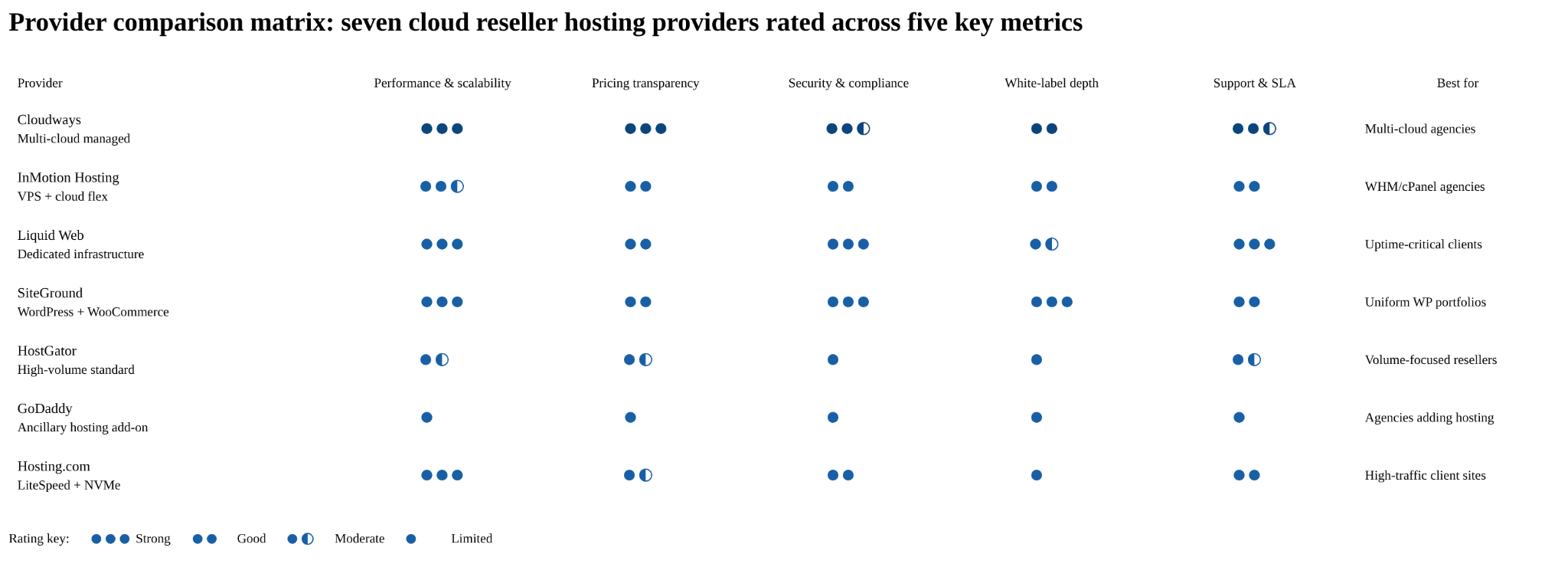
Elastic scalability: Cloudways and Liquid Web are the winners. SiteGround and Hosting.com top the list for raw per-request performance for typical WordPress workloads. HostGator and GoDaddy are good enough for low to medium traffic sites.
Pricing and Total Cost of Ownership
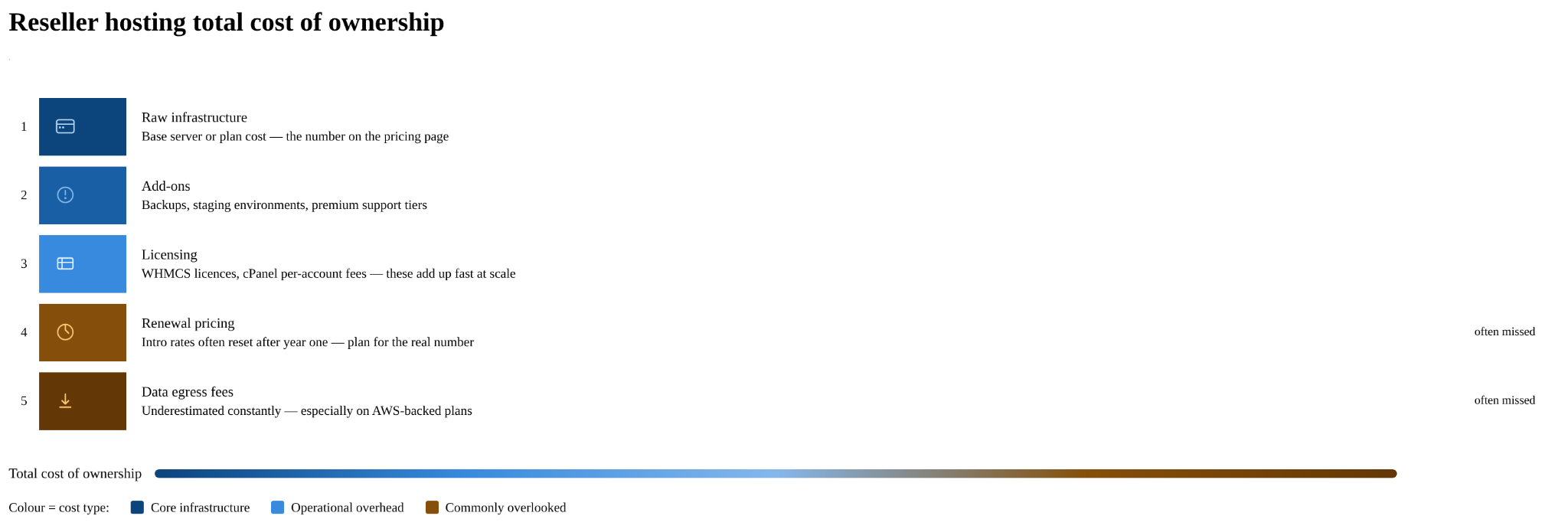
Sticker price isn't the whole story. When building your financial model, account for:
- Raw infrastructure cost: the base server or plan cost
- Add-ons: backups, staging environments, premium support tiers
- Licensing: WHMCS licenses, cPanel per-account fees (these add up)
- Renewal pricing: introductory rates often reset after year one
- Data egress fees: underestimated constantly, especially on AWS-backed plans
Cloudways' pay-as-you-go model is genuinely transparent by industry standards. InMotion and Liquid Web use more traditional fixed-tier pricing, which is easier to forecast but less flexible. GoDaddy and HostGator often have attractive intro pricing that normalizes upward, so factor that into your year-two margins.
Security and Compliance
All providers on this list have SSL. That’s not a differentiator; that’s the floor. The real security differentiators at the platform level in 2026:
- Is it a generic WAF, or one that’s actively maintained against the current threat vectors?
- Zero Trust frameworks: Is the principle-of-least-privilege access control the default?
- Compliance tools: Is there documentation for GDPR and PCI compliance available on the platform for your clients?
- Observability: Are you able to see issues across client accounts from a central dashboard, or do you have to log into each client account?
SiteGround has a custom WAF,, and Cloudways has a unified security dashboard and both are great here. Liquid Web’s dedicated infrastructure makes compliance conversations easier for regulated industries.
White-Label and Branding
White-labeling can be as deep as you want. At the very least, you want branded client dashboards, custom invoice templates, and the ability to use your own domain for the control panel.
SiteGround has agency tools. InMotion’s white label implementation is good, but not as polished. HostGator and GoDaddy offer less rebrandability: enough for basic use, but not if the client experience is central to your brand promise. Cloudways offers branded billing.
Support and SLAs
Published SLAs matter, but so does the actual support experience. A 99.9% uptime SLA means about 8.7 hours of acceptable downtime per year. A 99.99% SLA (Liquid Web's standard) means roughly 52 minutes. Know which one you're signing up for.
Beyond uptime, look for: 24/7 live support (not just ticketing), onboarding assistance for your first client migrations, and clear escalation paths when something goes wrong. Cloudways and Liquid Web consistently rank well on support responsiveness. GoDaddy and HostGator are more variable.
How to Launch Your Cloud Reseller Hosting Business
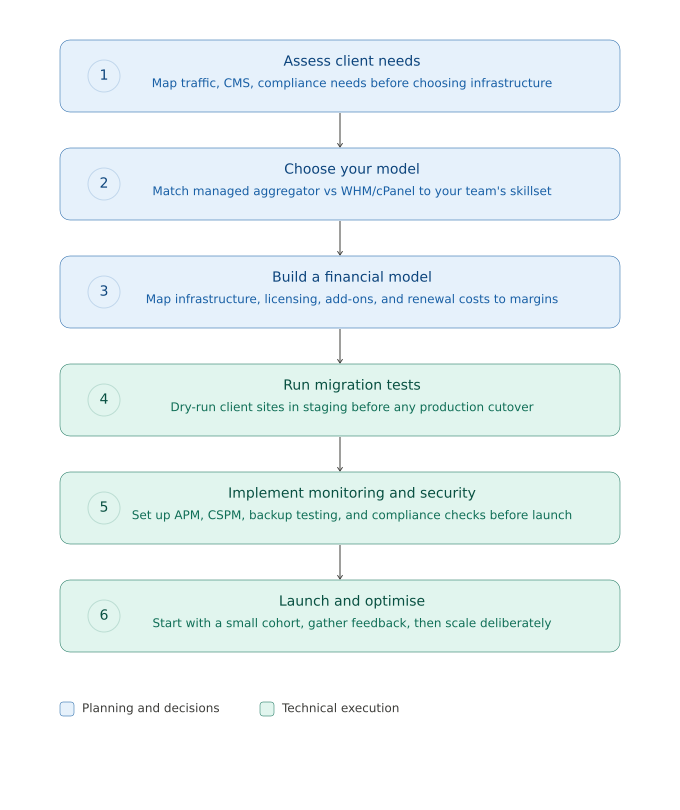
Step 1: Identify Your Clients’ Real Needs
Before you decide on a platform, interview likely clients or think about the kinds of sites you’ll be managing. The right questions: What CMS do they use? What are their monthly numbers? Are they in a regulated industry (healthcare, finance, legal, etc.)? What’s the 12-18 month growth expectation?
These answers will dictate your infrastructure needs. A portfolio of low-traffic WordPress sites needs very different things than three high-traffic ecommerce stores.
Step 2: Fit the Model To Your Skill Level
If your team is technically sound and you care more about margins, then traditional WHM/cPanel gives you more control over costs. For example, if your advantage is customer service and speed, a managed aggregator like Cloudways allows you to focus on that.
Don’t pick a model that requires skills your team doesn’t have and isn’t planning to build.
Step 3: Build a Financial Model Before You Commit
Map out:
- Monthly infrastructure cost at projected client count
- Licensing fees (WHMCS, cPanel)
- Support labor (hours per client per month, realistically)
- Add-ons (backups, staging, premium security)
- Renewal pricing for year two and beyond
Then work backwards from your target margin. Most agencies shoot for 40–60% margin on hosting, so make sure your chosen platform can support that at the client volume you're targeting.
4. Run Migration Tests Prior to Going Live
Do a dry-run for at least two or three representative client sites before bringing the whole portfolio on board. Test compatibility and performance under load. Verify backup/restore functionality in staging environments.
Production surprises are expensive. Surprises in staging come free.
Step 5. Starting from Day One Monitor & Lock
Don’t add monitoring when something breaks. Pre-production APM (application performance monitoring) setup before clients go live. Set up automated recovery testing for backups. If you serve regulated industries, review the provider’s compliance certifications.
It’s worth integrating Cloud Security Posture Management (CSPM) tools early so they can surface misconfigurations before they become incidents.
Step 6: Launch and Optimize in Phases
Start with a few clients, get feedback, and improve the onboarding process before scaling. Package your services smartly: core hosting, with value-added levels (managed updates, premium backups, priority support). Packaging decisions you make early, compounding recurring revenue, affect your business for years.
Best Cloud Reseller Hosting Providers – Concluding Remarks
Cloud reseller hosting in 2026 is very mature. The infrastructure is solid, the platforms are polished and the economics can work very well for agencies that take it seriously.
The most important decision is not which provider has the best marketing. It’s about selecting a model that fits how your team actually works. Your team isn’t technically deep enough to keep a perfectly configured WHM environment, and it helps no one. If the limitations of a managed aggregator don’t affect the services your clients really require, then they’re not important.
Choose the platform that minimises friction between you and your clients and build from there.
Frequently Asked Questions About Cloud Reseller Hosting Providers
What are the advantages of cloud reseller hosting?
The three core benefits are scalability, white-label branding and managed infrastructure. You can offer enterprise-class hosting to your customers under your own brand name, without having to build or manage the underlying infrastructure yourself.
What is the difference between managed reseller platforms and traditional reseller hosting?
Managed platforms shoulder the operational burden through automation of backups, scaling, and security at the platform level. Reseller hosting the traditional way gives you more control over your server via WHM/cPanel, but gives you more responsibility to manage it.
What are the key features for agencies that manage multiple client sites?
Reliable uptime, automated backups, white label dashboards, integrated billing, and quick support response times. As the portfolio expands, unified observability across all client accounts becomes more and more important.
How do I scale resources as my client base grows?
On cloud-native platforms, scaling is usually on-demand. You add CPU, RAM, or storage through the dashboard without migrating. On fixed-tier platforms, you'll move up to the next plan. The former is more flexible; the latter is more predictable.
What often gets missed in reseller hosting cost estimates?
Data egress fees, WHMCS licensing, cPanel per-account fees, and year-two renewal pricing. These costs are frequently overlooked during evaluation and can meaningfully compress margins if not planned for upfront.